Since the early 1990s, the Federal Association Information and Advice for Survivors of Nazi Persecution has been committed to promoting the rights, recognition and support of people who suffered under Nazi persecution. Established through the commitment of survivors, human rights organisations and civil society initiatives, the Association continues to serve as an important point of contact for survivors of Nazi persecution, their relatives and subsequent generations.
The idea of establishing an independent information and counselling centre for survivors of Nazi persecution - particularly for the so-called “forgotten victims” -emerged in the late 1980s.
Representatives of various organisations of survivors of Nazi persecution, together with Pax Christi and Aktion Sühnezeichen Friedensdienste (Action Reconciliation Service for Peace), joined forces to provide support to those affected in matters relating to compensation, recognition and social benefits.
From this first counselling centre, the Federal Association Information and Advice for Survivors of Nazi Persecution was established in 1992. Its mission was to inform survivors of Nazi persecution about existing compensation schemes and to support them throughout often complex compensation claims procedures.
Since the 1990s, the Federal Association has successfully advocated for improving the living conditions of survivors of Nazi persecution in Germany. One important milestone was the establishment of a hardship fund for survivors of Nazi persecution in the state of North Rhine-Westphalia. This made it possible to support people who had previously received little or no compensation.
In 1997, the Transfer Office for Victims of Nazi Persecution in North Rhine-Westphalia (Transferstelle für NS-Opfer in Nordrhein-Westfalen) was established. To this day, it provides advice on compensation claims, social security benefits and services for older survivors of Nazi persecution.
To assist former forced labourers who were unable to prove their forced labour history, the Federal Association developed the Evidence Documentation Project together with the German Federal Archives (Bundesarchiv) and the International Tracing Service (ITS) of the Red Cross (Internationalen Suchdienst des Roten Kreuzes).
Within this archive network, the partners worked together to help those affected obtain the missing documents as quickly as possible. Requests submitted by former forced labourers without documentary evidence were first forwarded to the International Tracing Service and checked against its name index containing more than 47 million records. Only if no evidence could be found there were the requests forwarded to the archive network's central coordination office at the Federal Association in Cologne. From there, they were distributed to regional and municipal archives as well as to major corporate archives, including those of Mannesmann, Krupp and Degussa.
Overall, the archive network succeeded in obtaining documentary evidence for more than 43,000 former forced labourers, enabling them to receive financial compensation.
From an early stage, the Federal Association also became active beyond Germany.
In 1995, together with the American Jewish Committee, it organised a campaign to support survivors of Nazi persecution in Central and Eastern Europe.
The aim was to draw attention to the often difficult living conditions of many survivors and to provide practical assistance.
From the very beginning, the Federal Association has advocated for people who were long denied recognition as victims of Nazi persecution.
In particular, it campaigned for the rights of victims of Nazi military justice and former forced and slave labourers. Through political advocacy, public awareness work and counselling, the Federal Association contributed to these groups receiving increasing social and legal recognition by the turn of the millennium.
Between 2005 and 2007, the Federal Association drew attention to the challenges faced by traumatised survivors of Nazi persecution in residential and institutional elderly care and advocated for improvements to their living conditions. Everyday situations in care facilities - such as shared rooms, the death of a roommate or certain hygiene procedures - can trigger long-suppressed traumatic memories. These severe psychological burdens are often compounded by survivors' fear of encountering former perpetrators.
As many survivors have grown older and passed away, the work of the Federal Association has expanded. Today, the Association not only supports surviving victims of Nazi persecution but also their children, grandchildren and other descendants. At the same time, it is actively engaged in historical-political education, remembrance culture and the fight against antisemitism, antiziganism, racism and other forms of group-focused enmity.
The work of the Federal Association is rooted in the experiences of those who survived National Socialism. Their commitment to justice, recognition and humanity continues to shape the organisation's work today. This history gives rise to a lasting responsibility: to keep remembrance alive and to actively oppose hatred, exclusion and discrimination.
Among the most influential figures in the history of the Federal Association was Prof. Felix Kolmer. A survivor of the Theresienstadt Ghetto and Auschwitz, he dedicated his life to advocating for compensation, justice and reconciliation.
He served on the Board of the Federal Association for almost twenty years. From 2000 to 2005 and again from 2008 to 2012, he was Deputy Chairperson, before serving as Chairperson from 2012 to 2021. During this time, he played a defining role in shaping the Association's work and was particularly committed to ensuring that all groups persecuted by the Nazi regime received recognition and support.
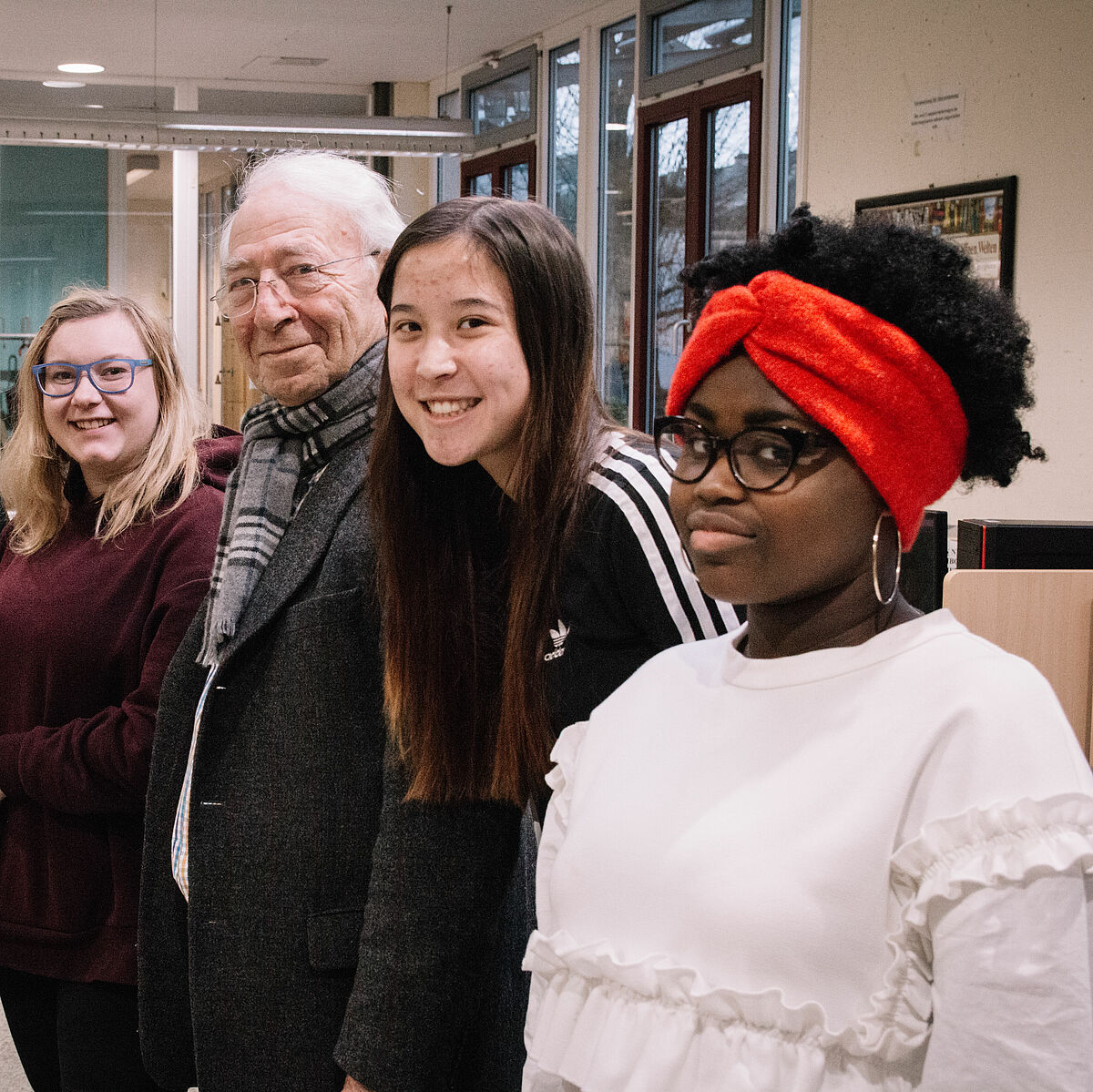
Beyond his work on the Board, Felix Kolmer shared his experiences as a contemporary witness at Storytelling Cafés, in schools and at public events. His message to younger generations remains as relevant today as ever:
“You bear no guilt for what happened. But you do bear the responsibility to ensure that it never happens again.”
Through his lifelong commitment, Felix Kolmer built bridges between survivors, subsequent generations and society as a whole. Those bridges remain strong to this day.
He is deeply missed - by us and by the world. May his memory be a blessing.
Dr Brigitte Unkel-Brösecke was a dedicated companion and supporter of the Federal Association Information and Advice for Survivors of Nazi Persecution for many years. Through her expertise, experience and voluntary commitment, she made an invaluable contribution to the development and strengthening of the Association's work.
She became involved as a volunteer when the Cologne Community and Testimony Cafés was established in 2005. The café developed into an important place of encounter for survivors of Nazi persecution, their families and members of the wider public. In recognition of this commitment, she received the City of Cologne Volunteer Award in 2012 on behalf of the volunteers of the Cologne Community and Testimony Café.
From 2012 to 2021, Dr Unkel-Brösecke served as a member of the Board of the Federal Association. During this period, she played an important role in the Association's continued development and provided valuable impetus for its remembrance and educational work.
Her sharp intellect, her thoughtful yet compassionate approach and her unwavering commitment to survivors of Nazi persecution and their families will not be forgotten. Her work has left a lasting mark on the history of the Federal Association.